কালা ভুনা - Kala bhuna
কালা ভুনা - blackened and roasted beef
Rare? Medium-rare? Such distinctions feel trifling when compared to a cut of beef pushed to the very lip of the void. Here, the meat is carbonized into a dark, tectonic luster. An obsidian shell that fractures to reveal a core of deep, spice-blackened velvet. If Prometheus were chained to the rock for stealing fire from Olympus, let this be the justification for his agony; slow-scorched meat that makes his eternal binding feel like bargain bin pricing.
Look, I just really like Kala Bhuna, guys.
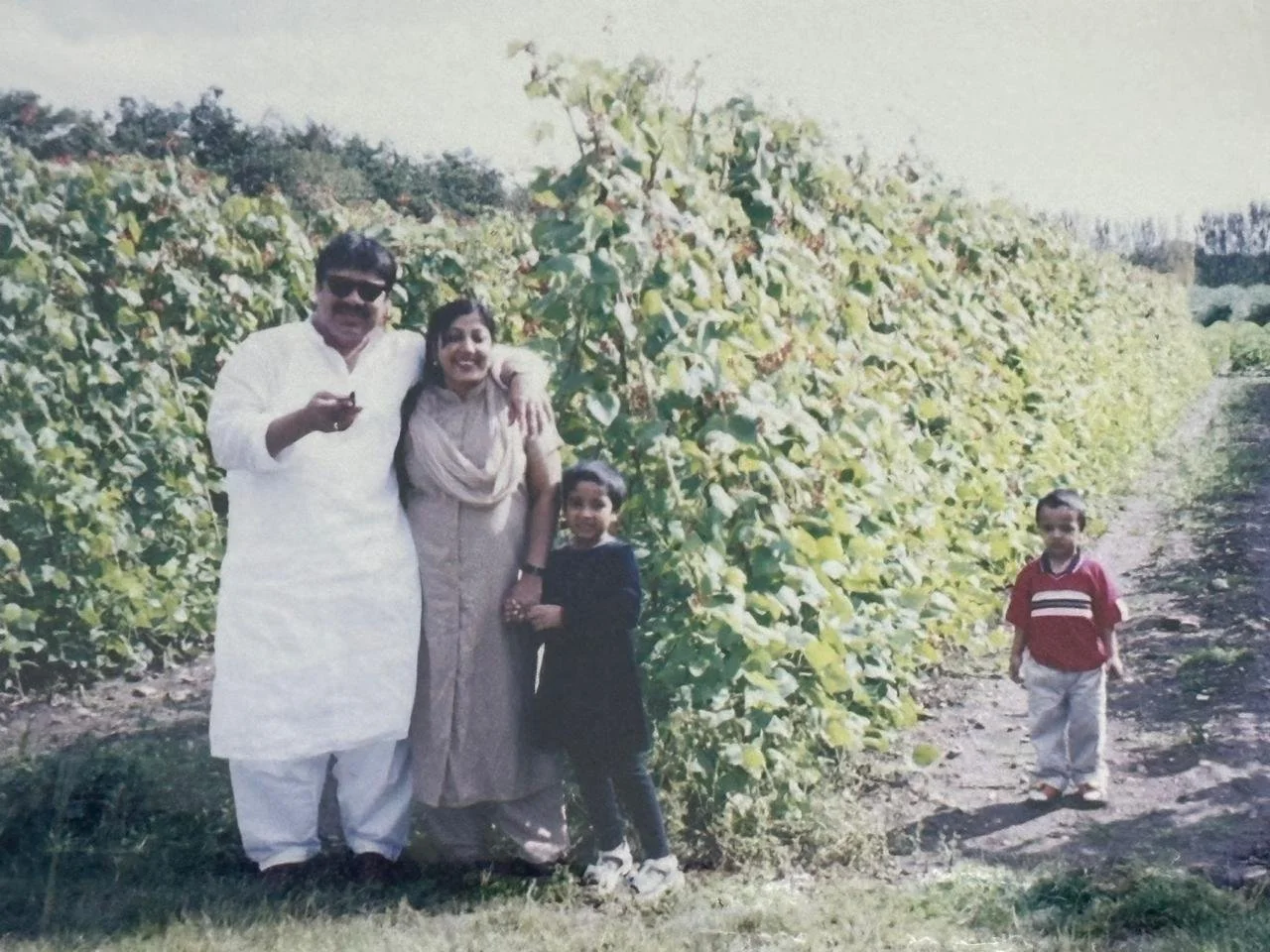
I do not have a multi-generational family epic to anchor this particular recipe. In fact, my primary 'origin' photo is a point of contention. That image on the cover? It was taken on a strawberry farm, allegedly. To me, the leaves look like grapes, but I’ll meet my dad halfway on the nomenclature and say that they are the strawberry grapes commonly seen in the British Isles.
In the photo, you see my mum, dad, and older sister to one side (all quite jolly) and me on the other, looking thoroughly displeased. I was an unfashionably ill-tempered boy. There’s no deep lesson there, except perhaps that my fiery nature was eventually tempered by the very heat of the pot. I am no longer that angry kid, and maybe that is because the Kala Bhuna does the burning for me.
Budget 20 minutes of prep time, and a minimum of 90 minutes of cook time, with minimal active cook time. This is a slowwww recipe sometimes. Clear your afternoon.
Play with it all you want. Your end result should be a dark, dry, spiced beef that goes best with a bowl of rice or some dry bread. My only homebrew variation brings it closer to a rendang.
The Vessel of choice
Heavy-bottomed pot with a tight lid or a Dutch Oven.
Ingredients
2 lbs Stew Beef: Chuck is best. Anything pricier is better used elsewhere
1/2 cup Mustard Oil: Or neutral oil tempered with black mustard seeds
1.5 cups Onions/Shallots: Sliced thin
1 tbsp Garlic Paste & 1 tbsp Ginger Paste.
Spices (Whole): 2 black cardamom pods (crushed), 1–2" cinnamon stick, 3 cloves, 1 bay leaf, 3 dry red chilies, 1–3 bird’s eye chilies
Spices (Ground): 1 tbsp chili powder (2 if you want it spicy), 1 tbsp black pepper, 2 tbsp cumin, 1 tbsp coriander, 1 teaspoon turmeric (this is a matter of taste, you can omit it), 1 tsp mustard powder
Finishing: 1 tbsp garam masala, salt to taste (approx. 1 tbsp)
Garnish: Fresh cilantro and lime wedges
Instructions
In a large bowl, combine the mustard oil, ginger/garlic pastes, and all spices (except the finishing garam masala). Add the beef and toss until every piece is thoroughly coated.
Heat a small amount of neutral oil in your pot. Fry the sliced onions/shallots over medium heat until they are deeply browned.
Add the marinated beef to the pot. Stir well to incorporate the onions. Sauté until the oil separates from the spice mixture. This step requires a little patience and i promise the oil will split!
Let the beef fry until the oil separates. This may take some time but you need to be patient. Take some time, mix it up, and eventually the oil will split.
When the spices begin to stick to the sides of the pot, add 1/2 cup of water.
As the water evaporates, continue adding small amounts (about 1/4-1/3 cup at a time). Repeat this process until the beef is tender enough to break apart with the edge of a spatula.
If there is too much liquid at the end, cook uncovered at medium heat for 5–10 minutes until the sauce is thick and clings to the meat.
Stir in the salt, garam masala, and a final pinch of cumin.
Tips and tricks
If you make this recipe, please do let me know how it goes. If you have any questions at any point, text or call me for advice, and advice will be readily given.
Some people add curd to the marination step or the hydration step (step 6). It does two things:
The lactic acid in curd gently denatures the beef's proteins.
Curd contains fats and solids that help the spices stick to the meat. As the water evaporates during your hydration cycles, the curd solids fry down into the "ore" giving the final dish a characteristic matte-black sheen.
I avoid it while in New York for two reasons - I have found Greek Yoghurt to be a poor substitute for curd. I have tried to make greek yoghurt work but to little to no avail. Curd (also referred to as Doi/Dahi in Southasia and Indopaks) is more acidic. If you do use Greek Yoghurt, thin it out and add a little water, to avoid clumping.
You may wish to note the above,
Nafis